10 Powerful Ways Student-Athletes Can Find Balance and Thrive During the Holidays
Keep the Main Thing the Main Thing: Finding Balance Between Academics, Athletics, Family, and Rest.
The holiday season is supposed to be a time of celebration, connection, gratitude, and rest. But for many high school student-athletes, November and December can feel like anything but a break.
There are midterm exams and final projects to complete. Winter sports are getting underway, while fall sports may be wrapping up with postseason competition. College recruiting conversations continue. Families are planning holiday gatherings, traveling to visit relatives, and trying to squeeze in traditions that make this time of year special.
And somewhere in the middle of it all, student-athletes are expected to perform academically, compete athletically, maintain friendships, and prepare for their futures.
That’s a lot for anyone, especially a teenager.
At Find My Team, we believe developing a successful student-athlete means looking beyond athletic performance. It means helping young people build healthy habits, develop confidence, manage responsibilities, and recognize that their value extends far beyond the scoreboard.
One of the most important lessons we can teach student-athletes during this busy season is surprisingly simple:
Keep the main thing the main thing.
- When it’s time to study, study.
- When it’s time to compete, compete.
- When it’s time to celebrate with family, be fully present.
- When it’s time to rest, give yourself permission to truly rest.
The goal isn’t to do everything at once. It’s to give your attention and energy to what matters most in the moment.

Why the Holiday Season Can Be Especially Challenging for Student-Athletes
For high school student-athletes, November and December often represent the intersection of several demanding schedules.
Academically, the pressure increases as the semester comes to a close. Teachers assign final projects, exams approach, and students work to maintain or improve their grades.
Athletically, winter sports teams are establishing expectations, developing chemistry, and beginning competition. Fall athletes may be finishing demanding seasons, while spring athletes are preparing for what’s ahead.
For athletes interested in competing in college, there may also be recruiting emails to answer, conversations with coaches, campus visits to consider, and important decisions to make.
Then come the holidays.
Thanksgiving gatherings, school celebrations, religious observances, family traditions, community events, and travel all compete for limited time.
The challenge isn’t necessarily that student-athletes have too many things to care about. It’s that they often feel pressure to give everything their full attention simultaneously.
That’s where stress begins to build.
A student might be sitting at Thanksgiving dinner worrying about an upcoming exam. Another might be at practice thinking about an unfinished assignment. Someone else may be enjoying a holiday break but feeling guilty about not training.
When our minds are constantly focused on what’s next, we miss what’s happening now.
Balance doesn’t mean giving every responsibility equal time. It means giving the right responsibility your full attention at the right time.
That distinction can change how student-athletes experience the holiday season.
1. When Academics Are the Priority, Give Them Your Best
Let’s begin with something every student-athlete needs to understand: academics are not something you squeeze in around athletics.
They are a fundamental part of your development and future opportunities.
As a former Division I basketball coach, I can tell you that athletic ability may open a door, but academic preparation helps determine which doors remain available.
Your grades, study habits, communication skills, and ability to manage responsibilities matter.
During exam season, your primary responsibility is to prepare yourself academically.
That doesn’t mean abandoning athletics. It means recognizing when studying deserves your undivided attention.
Five ways to prepare academically:
- Start earlier than you think necessary. Don’t wait until the night before an exam to begin reviewing. Break larger assignments into manageable pieces and create a realistic study schedule.
- Eliminate distractions. Put your phone away, close unnecessary browser tabs, and find an environment where you can concentrate. Thirty focused minutes can be more productive than two distracted hours.
- Communicate with teachers. If travel, competition, or family commitments create scheduling conflicts, talk with your teachers early. Taking responsibility demonstrates maturity.
- Use your available resources. Teachers, tutors, classmates, counselors, and study groups can provide valuable support. Asking for help is a strength, not a weakness.
- Protect your sleep. Staying up all night studying may feel productive, but sleep plays an important role in memory, learning, mood, and physical recovery.
Here’s an important reminder: Being a committed athlete doesn’t excuse you from being a committed student.
When it’s time to study, put your energy into learning. Your sport will still be there when you finish. And you’ll return to it with one less responsibility weighing on your mind.
2. When It’s Time to Compete, Be All In
Sports provide incredible opportunities for young people to develop discipline, teamwork, resilience, and leadership.
But those lessons require presence.
When you step onto the court, field, mat, ice, track, or into the pool, your coach and teammates deserve your attention.
That means being mentally engaged, physically prepared, and emotionally invested in the team.
It also means recognizing that competition is about more than your individual performance.
What does being fully present in sports look like? It means:
- listening when your coach is teaching.
- encouraging a teammate who is struggling.
- understanding your role and fulfilling your responsibilities.
- responding constructively when something doesn’t go your way.
- competing with effort, integrity, and enthusiasm.
One of the greatest qualities a student-athlete can develop is the ability to focus on the next play rather than dwelling on the previous mistake.
That same mindset applies to life.
If you had a difficult exam earlier in the day, acknowledge it, learn from it, and redirect your attention when practice begins. If you’re concerned about something happening at home, communicate with a trusted adult or coach when appropriate rather than feeling you must handle everything alone.
Being present doesn’t mean pretending problems don’t exist. It means learning how to manage your attention while recognizing when you need support.
Coaches value athletes who show up ready to contribute, support others, and remain engaged. Those qualities are important in college recruiting, but they’re even more important in becoming a dependable teammate and person.
3. When It’s Family Time, Make It Family Time
One of the things I appreciate most about the holidays is the opportunity to reconnect with people who matter.
For student-athletes, those moments can be especially meaningful.
Athletic schedules often require sacrifices from the entire family. Parents drive to practices, attend competitions, adjust work schedules, and spend countless hours supporting their children.
Siblings sometimes spend weekends in gymnasiums or at tournaments instead of pursuing their own interests.
Grandparents, relatives, and family friends cheer from near and far.
The holidays offer an opportunity to recognize those relationships.
But there’s a difference between physically attending a family gathering and actually being present.
Imagine sitting at Thanksgiving dinner while scrolling through recruiting updates, checking social media, or worrying about tomorrow’s workout.
You’re technically at the table, but you’re missing the experience.
Give your family the gift of your attention
- Put your phone away for part of the gathering.
- Ask your grandparents about their childhood traditions.
- Help prepare a meal or clean up afterward.
- Play a game with younger cousins.
- Listen to stories you’ve heard before, because someday you may wish you could hear them again.
- Laugh.
- Connect.
- Participate.
Not every meaningful moment in your life will involve a trophy, scholarship, championship, or athletic accomplishment.
Some of the most valuable memories are created during ordinary moments with people who love you. And remember, families look different. Whether you’re celebrating with parents, grandparents, guardians, relatives, friends, or another support system, what matters is connection.
You don’t have to earn the right to enjoy your family by first accomplishing something in sports.
Your relationships matter because you’re a person, not because you’re an athlete.

4. Understand That Rest Is Part of Becoming a Better Athlete
Here’s a message that some student-athletes need to hear more often:
Recovery isn’t time taken away from becoming a better athlete. It’s one of the ways you take care of the person behind the athlete.
Many young athletes have been conditioned to believe that improvement requires constant activity. More workouts, repetitions, training sessions, and more time in the gym. But while consistency and discipline are important, so are recovery and balance.
Physical training places stress on the body. Appropriate recovery helps athletes adapt to that training and prepare for future demands. Mental recovery matters, too.
Student-athletes spend significant time responding to expectations, evaluating performance, managing schedules, and trying to improve. Without opportunities to disconnect, even something they love can begin to feel exhausting.
The holiday season may provide a valuable opportunity to recharge.
That doesn’t necessarily mean doing nothing for two weeks. It means understanding what your body and mind need and respecting those needs. For some athletes, that might mean sleeping a little longer. For others, it might mean taking a walk, reading a book, or spending an afternoon with friends. Some may enjoy volunteering, watching a movie, listening to music, or simply having an unstructured day.
Healthy ways to recharge during holiday breaks
- Sleep: Maintain a healthy routine and allow your body the recovery it needs. Most teenagers need approximately 8–10 hours of sleep per night.
- Read something enjoyable: Choose a book unrelated to school or sports.
- Spend time with friends: Build relationships outside your athletic identity.
- Serve your community: Volunteer at a food pantry, participate in a holiday service project, or help someone who needs support.
- Explore another interest: Cook, create art, play music, visit a museum, or try something new.
- Enjoy quiet time: Take a walk, practice breathing exercises, or simply enjoy a few moments without a schedule.
Of course, athletes should follow appropriate team commitments and communicate with coaches or qualified professionals about recovery needs. But when a genuine break is available, take advantage of it.
You are allowed to enjoy life without turning every moment into an opportunity for athletic improvement.
In fact, developing interests and relationships beyond sports can contribute to a healthier sense of identity.
5. Stop Confusing Being Busy With Being Productive
One of the biggest challenges facing today’s student-athletes is the belief that every available minute must be filled. Between school, athletics, recruiting, social media, and extracurricular activities, many teenagers have very little unscheduled time. But a packed calendar isn’t necessarily a productive calendar. And constant activity doesn’t automatically lead to success.
Sometimes the most productive decision is to stop, prioritize, and complete one responsibility before moving to the next.
Consider two student-athletes.
The first tries to study while answering messages, watching recruiting videos, and thinking about practice.
The second studies for a focused period, finishes the assignment, and then enjoys time with friends.
Both spent time studying, but the second athlete gave that responsibility more meaningful attention.
The same principle applies to practice, competition, family events, and recovery. Multitasking often feels efficient, but switching constantly between demanding tasks can interfere with concentration.
Instead of asking, “How can I fit more into my day?” try asking: “What deserves my attention right now?”
That question encourages intentional decisions rather than automatic reactions. And it’s a habit that can benefit student-athletes long after their playing careers end.

6. Keep College Recruiting in Perspective During the Holidays
For student-athletes hoping to compete in college, recruiting can add another layer of pressure during an already busy season. Athletes may feel they need to constantly communicate with college coaches, update recruiting profiles, create highlight videos, or research schools.
Those activities can be important. But recruiting should be approached with a plan, not with the belief that every waking moment must be devoted to it.
At Find My Team, we encourage student-athletes to take ownership of their recruiting journey while maintaining perspective. That means understanding priorities, communicating appropriately, and making thoughtful decisions.
During the holidays, think about setting aside a specific time each week for recruiting responsibilities. Use that time to respond to coaches, update information, research colleges, or review your goals.
Then allow yourself to focus on other areas of life.
If a coach has established a deadline or important communication expectation, honor it. Otherwise, not every recruiting task requires an immediate response. And remember that college fit involves much more than athletic opportunity. College coaches are recruiting people who will become students, teammates, roommates, and members of a campus community. Developing healthy habits, meaningful relationships, independence, and personal interests is part of preparing for that future.
The recruiting process should help you discover who you are and where you belong, not consume every part of your identity.
7. Parents: Help Create Balance Without Adding More Pressure
Parents and guardians play an important role in helping student-athletes navigate busy seasons. Your support can make a tremendous difference. But sometimes, even well-intentioned encouragement can unintentionally add pressure. Questions about playing time, recruiting opportunities, grades, training schedules, and future goals can begin to dominate family conversations.
During the holidays, consider giving your student-athlete some space to simply be a teenager. Not every conversation needs to involve sports, or become a recruiting discussion, or lead to additional workouts.
Five ways parents can help
- Model presence. Put your own phone away during meaningful family moments.
- Help establish priorities. Discuss upcoming responsibilities and encourage realistic planning.
- Respect recovery. Recognize when your student-athlete needs rest or a break from performance-related conversations.
- Celebrate the whole person. Acknowledge kindness, effort, academic growth, responsibility, and character—not just athletic accomplishments.
- Listen before advising. Sometimes your teenager needs someone to hear them rather than immediately solve a problem.
One of the greatest gifts parents can give their student-athletes is the reassurance that their love and support aren’t dependent on athletic success. That foundation helps young people develop confidence and perspective.
8. Build a Simple Holiday Game Plan
Balance doesn’t happen automatically. It requires intention. Before the holiday season becomes overwhelming, encourage your student-athlete to create a simple plan.
Start by identifying important dates: exams, assignment deadlines, practices, competitions, travel, and family gatherings. Then determine which responsibilities require advance preparation. Finally, identify opportunities for rest and enjoyment.
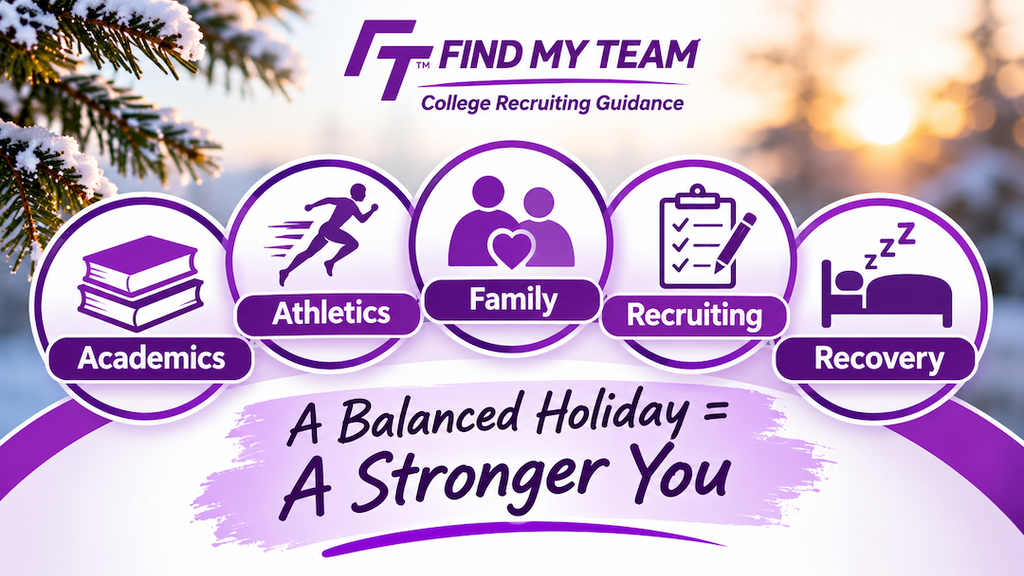
Here’s a simple framework:
| When the priority is… | Your commitment is… |
|---|---|
| Academics | Prepare, concentrate, ask for help, and do your best. |
| Athletics | Show up ready, compete with effort, and support your team. |
| Family | Put distractions aside and connect with the people around you. |
| Recruiting | Follow your plan, meet important deadlines, and maintain perspective. |
| Recovery | Rest, recharge, and enjoy activities that restore your energy. |
The goal isn’t to create a rigid schedule that accounts for every minute. It’s to establish enough structure that student-athletes can approach each responsibility with greater confidence. And when the unexpected happens—as it inevitably will—adjust. Flexibility is part of balance.
9. Recognize When Balance Is Slipping Away
Even with good intentions, the holiday season can become overwhelming. Student-athletes should pay attention to signs that their schedules, expectations, or stress levels may be affecting their well-being.
Persistent exhaustion, difficulty sleeping, irritability, declining motivation, trouble concentrating, or losing enjoyment in activities they once loved can signal a need for additional support. These experiences don’t automatically mean something is seriously wrong, but they deserve attention.
Talk with a parent, guardian, school counselor, coach, athletic trainer, or healthcare professional when concerns persist. Sometimes the best decision is to adjust a schedule, reduce unnecessary commitments, or ask for help. Strength isn’t measured by how much pressure you can endure without saying anything.
Real strength includes recognizing your limits and taking responsibility for your well-being.
10. Remember What Really Matters
Years from now, most student-athletes won’t remember every grade, every practice, or every result from a December competition. But they may remember the holiday they spent laughing with their grandparents. Maybe they remember the teammate who encouraged them during a difficult game. Most certainly they’ll remember the teacher who stepped up to help them prepare for an important exam or project. They may remember an afternoon spent volunteering and discover how meaningful it feels to help someone else.
These experiences aren’t distractions from becoming a successful student-athlete. They’re part of becoming a successful person.
As we enter the holiday season, I encourage every student-athlete to remember that you don’t have to do everything at once.
- Give your academics the preparation they deserve.
- Keep your commitments to teammates and coaches.
- Be present with your family and friends.
- Recover when your body and mind call for it.
- Give yourself permission to enjoy the season.
Because learning to manage your attention, responsibilities, and relationships is about much more than surviving a busy November or December. It’s about developing habits that will serve you in college, in your career, and throughout your life.
Leadership author, Steven Covey, popularized the saying, “The main thing is to keep the main thing the main thing.”
For student-athletes and families, that wisdom takes on special meaning during the holidays. The main thing changes throughout the day. Sometimes it’s academics. Sometimes it’s competition. Sometimes it’s family. And sometimes it’s allowing yourself to rest.
Whatever matters most in the moment, give it your best. Then move forward knowing you were fully present for what mattered.
A Final Thought From Find My Team
At Find My Team, we believe that the college recruiting journey should support the development of the whole student-athlete.
Our mission isn’t simply to help young people find a college where they can compete. It’s to help them discover an environment where they can grow academically, athletically, socially, and personally.
That starts with understanding who they are, what matters to them, and what they need to thrive. The holidays offer a wonderful opportunity to practice those lessons.
Your future is important. But so is the life you’re living right now.
You can, and should, enjoy both.
Need Guidance on Your Student-Athlete’s Journey?
The college recruiting process can feel overwhelming, especially when combined with academics, athletics, and family responsibilities. You don’t have to navigate it alone.
At Find My Team, we help student-athletes and families build a thoughtful recruiting strategy centered on individual strengths, priorities, and long-term fit.
Schedule a Free Recruiting Strategy Session with Find My Team and discover how the right guidance can help your student-athlete move forward with clarity, confidence, and balance.